The short answer, and what we could not confirm
The bottom line for July: the Polk County rules confirmed here (a 10-foot setback from water, rate caps, no application for 30 days after sodding or seeding, and no nitrogen or phosphorus before heavy rain or in severe weather) are not a summer ban, and whether your city adds one is the open question, so check with your city and UF/IFAS Extension Polk County. Many Florida counties bar nitrogen and phosphorus fertilizer through the summer rainy season, and the dates June 1 to September 30 are the best-known version. For this guide we went looking for a Polk County ordinance behind them, and we could not find one. Every Polk-specific source we could open describes a different set of rules: a 10-foot buffer from water, limits tied to heavy rain and storms, a wait after seeding or sodding, and a cap on the amount applied each time. None of them gives a seasonal ban.
The clearest statement came from a Fox 13 report published May 29, 2026, on the fertilizer bans starting that month around Tampa Bay. It says that Polk and Pasco do not have seasonal bans and instead enforce year-round rules against applying fertilizer immediately before heavy rain or severe weather. A 2022 piece from the Sierra Club's Ancient Islands Group makes the same point from the other side, arguing that Polk's ordinance is weaker than the summer-ban ordinances in many other counties. Neither is the ordinance itself, and we could not open the county's current code. So treat this as our best reading of the evidence and not as legal advice, and confirm with the county before you rely on it. If you hold a different, official source that gives June 1 to September 30, the county's own text wins over this guide.
Where the June 1 to September 30 idea comes from
A UF/IFAS Extension publication on home lawn best practices notes that a number of Florida cities and counties have passed ordinances that do not allow nitrogen or phosphorus fertilizer during the summer. Those ordinances were passed out of concern about nutrients leaching with heavy rain. The bans that begin each June around Tampa Bay follow that pattern, which is why the dates are so widely repeated and why a Polk homeowner could easily assume they apply here.
The UF/IFAS Extension Polk County post that residents are sent to is also easy to misread. It opens by saying that on June 1 many local fertilizer ordinances start a blackout period, a time of year when no fertilizer containing nitrogen or phosphorus is to be applied, and then turns to what that means for Polk County. The rules it goes on to list are the ones in the next section. It does not give Polk blackout dates, and it does not say that Polk has one. Lawn companies, product labels and garden-center signs also often use the June to September dates used in many other counties, so a crew that stops feeding on June 1 may be following its own policy or a city rule and not the county's.
What the Polk County ordinance does restrict
According to the UF/IFAS Extension Polk County residents guide, written in June 2023, the county has had a fertilizer ordinance since 2013, aimed at reducing nutrients leaching and running off, mainly nitrogen and phosphorus. As the guide lists it: no fertilizer within 10 feet of a water body or wetland, with a low-maintenance zone inside that distance strongly encouraged; no more than 1 pound of slow-release nitrogen, or 0.5 pound of water-soluble nitrogen, per 1,000 square feet in a single application; and no nitrogen or phosphorus fertilizer before seeding or sodding or for the first 30 days afterward.
The same guide says that nitrogen or phosphorus fertilizer must not be applied during severe weather or when more than 2 inches of rain is likely within 24 hours. It adds housekeeping rules: fertilizer spilled on a driveway, sidewalk or road has to be removed, fertilizer and grass clippings must never be swept, washed or blown onto hard surfaces, storm drains or water, and spreaders need a deflector shield. The guide links to the full ordinance on the Polk County Water Atlas as a March 2013 version, and a file of that date on the Water Atlas is labelled a proposed ordinance. We could not retrieve it, and the guide is a summary, so check the current county text for anything that matters, such as exact wording and any amendments since.
Iron and micronutrient products
None of the Polk sources we opened addresses iron-only products. The one Polk-area ordinance we could read in full, a 2014 ordinance from the City of Fort Meade adopted at the county's request, restricts fertilizer containing nitrogen or phosphorus. Under that wording, a product with neither nutrient is not what the restrictions are aimed at, although the same ordinance defines fertilizer broadly as any substance with a recognized plant nutrient. That is our reading of one city's text, not a ruling on Polk County's, so ask the county or your city whether an iron-only product is treated differently.
Whatever the rule says, iron does a different job from nitrogen. UF/IFAS states that iron is not a substitute for nitrogen, that applying iron does not cure yellowing caused by a nitrogen shortage, and that iron fertilizer corrects an iron deficiency, with foliar iron products such as iron sulfate or chelated iron solutions named as the fix. A lawn that is pale from a lack of nitrogen will stay pale after an iron application. Our guide to St. Augustine Grass Turning Yellow: Causes and Fixes explains how to tell the two apart before you spend money on either.
Who the rules cover, and who enforces them
The county ordinance is described as countywide, but cities can and do adopt their own versions. Fort Meade adopted its ordinance in 2014. Its text says Polk County must comply with fertilizer regulations to keep its stormwater discharge permit and asked the city to adopt matching rules. It prohibits nitrogen and phosphorus fertilizer during National Weather Service storm and heavy-rain advisories, requires a 10-foot zone around water, and sets the same wait after seeding or sodding. It exempts golf courses, sports turf at parks and athletic fields, and farm and agricultural land. On enforcement it says violations in unincorporated Polk are enforced by the county under its own ordinances, and violations inside the city by the city.
We could not find the ordinances for Lakeland or Winter Haven. A third-party copy of the Haines City code includes a fertilizer article that refers to a prohibited application period without giving dates in the part we saw, so it is worth checking that city's rules directly. Florida law also sets a floor: under section 403.9337 of the Florida Statutes, local governments in the watershed of a nutrient-impaired water body must at least adopt the state model ordinance, and stricter rules require a documented, science-based case. The penalties the county itself applies are something we could not confirm. UF/IFAS Extension maintains a Florida fertilizer ordinance map that is meant to show which ordinance covers your address, though when we tried it the detail view asked for a login.
State rules that apply everywhere in Florida
Even where a local ordinance is silent, the state's urban turf fertilizer rule still shapes what is on the bag. According to UF/IFAS, bags under 50 pounds for home lawns carry directions that follow the rule. It allows up to 2 pounds of nitrogen per 1,000 square feet in spring or summer when the product is at least 65 percent controlled-release nitrogen, and no more than 0.7 pound of soluble, quick-release nitrogen at one time. Phosphorus is limited to 0.25 pound of P2O5 per 1,000 square feet per application and 0.5 pound a year, and no more may be applied unless a soil test shows a deficiency. A one-time starter fertilizer higher in phosphorus is allowed after planting a new lawn.
The bag must also say not to apply near water, storm drains or drainage ditches, not to apply if heavy rain is expected, and to sweep anything that lands on a hard surface back onto the lawn. Since January 2014, commercial crews that fertilize home lawns must hold the Florida Green Industries Best Management Practices certification and a limited certificate for urban landscape commercial fertilizer application, so asking a company to show both is a fair question. Whatever a crew or an article says, the label on the bag is the instruction you must follow.
What to feed a lawn in the off-season, according to UF/IFAS
The UF/IFAS advice is mostly about timing. Warm-season grasses grow fastest in summer, so that is when they use nutrients best, and fertilizing when the grass is not growing raises the chance of nutrients leaching, partly because roots slough off in winter. As a general rule, the first fertilizer application of the year in Central Florida should go on in early April, and St. Augustine is fed in two to six applications from spring green-up through fall. UF/IFAS says not to fertilize too late in the year after growth has subsided, and its Gardening Solutions page for St. Augustinegrass tells Central and North Florida owners to reduce watering and not fertilize in the cool months.
UF/IFAS also favors slow-release nitrogen, balanced with potassium based on a soil test, and a soil test for phosphorus. It publishes annual nitrogen ranges for each grass and region, and Central Florida St. Augustine is higher than bahiagrass; read the current table for your grass instead of a number from us. If you live in an area with a summer restriction, UF/IFAS suggests applying a long-term, controlled-release product before the restricted period begins, then switching to a product with a more soluble nitrogen component afterward so little nitrogen is released in winter. It also advises waiting 30 to 60 days after laying new sod before the first feeding. See our guide to How to Lay Sod in Florida: Step-by-Step Guide for the first weeks.
How to check your own address
Start with the UF/IFAS Extension Polk County office, which wrote the residents guide and can say how the ordinance applies to your property. For the legal text and penalties, ask Polk County government. If you live inside a city, ask the city, since municipal rules may differ from the county's. Lawn companies should be able to tell you which rule they follow, and your HOA may set its own schedule on top.
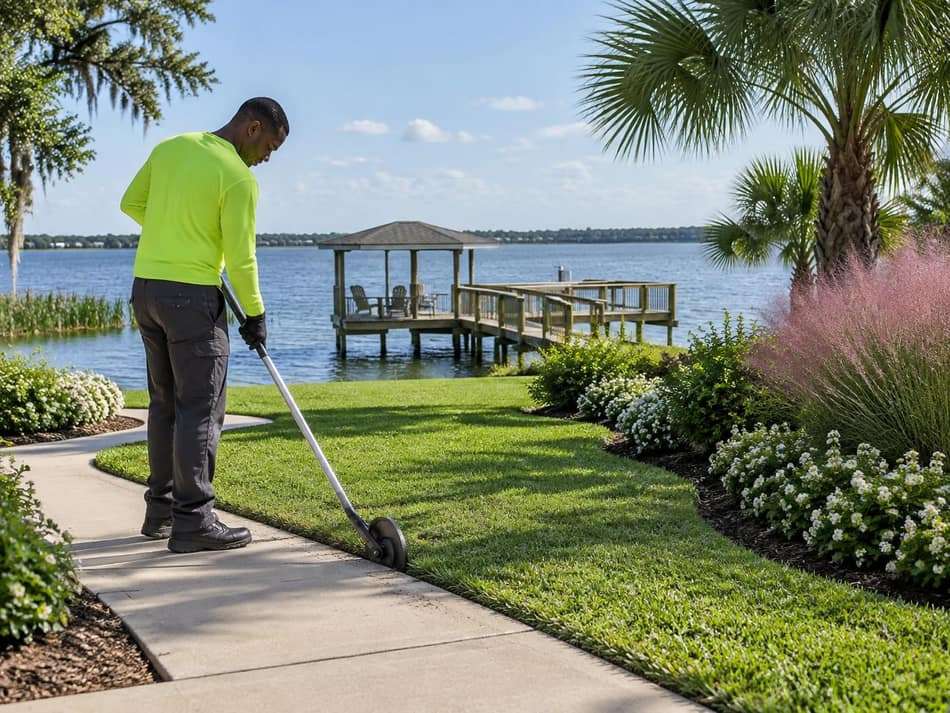
While you wait for an answer, the cautious habits cost little. Keep fertilizer 10 feet from any lake, pond or canal, which matters in a county with so many lakefront yards. Skip a feeding ahead of a storm or forecast of heavy rain. Sweep any granules off the driveway. Do not fertilize new sod right away. And if you want a summer pause for your own reasons, a soil test and our guide St. Augustine Grass Turning Yellow: Causes and Fixes will tell you more than a calendar will.
Sources
- UF/IFAS Extension Polk County: Residents Guide to the Polk County Fertilizer Ordinance
- FOX 13: Fertilizer bans in effect beginning in June across Tampa Bay Area (May 29, 2026)
- Sierra Club Ancient Islands Group: Despite Claims, Polk's Fertilizer Ordinance Falls Short (2022)
- City of Fort Meade Ordinance No. 14-03, Stormwater Management System Fertilizer Ordinance
- Haines City Code, Chapter 10 Environmental Protection (third-party copy)
- Florida Statutes 403.9337: Model Ordinance for Florida-Friendly Fertilizer Use on Urban Landscapes
- UF/IFAS Extension: Urban Turf Fertilizer Rule for Home Lawn Fertilization (ENH1089/EP353)
- UF/IFAS Extension: Homeowner Best Management Practices for the Home Lawn (ENH979/EP236)
- UF/IFAS Extension: St. Augustinegrass for Florida Lawns (ENH5/LH010)
- UF/IFAS Extension: General Recommendations for Fertilization of Turfgrasses on Florida Soils (SL21/LH014)
- UF/IFAS Gardening Solutions: St. Augustinegrass
Written by the Polk County Landscaping editorial team. Rules and prices change, so check the linked agency before you act. Spotted a mistake? Send a correction.