Typical sod installation cost in Florida
Published estimates for installed sod run from about $1 to $3.50 per square foot, and they do not agree. The Florida-specific figures sit at the low end. Lawn by Season, which publishes city-level estimates, lists $1.10 to $1.80 per square foot for Florida (typical $1.42) and $1.10 to $1.75 for Orlando, or about $2,200 to $3,600 for a 2,000 square foot lawn. HomeGuide lists $0.95 to $2.40 per square foot installed and $0.45 to $0.90 for the sod alone.
National figures run higher. Thumbtack reports $1,051 to $3,052 for a typical job, with an average near $1,779. Other 2026 cost guides in Google results quote $1.00 to $2.00 per square foot for basic installation and $2.12 to $3.54 when more preparation is needed. One homeowner in a Reddit landscaping thread was told to expect about $2.50 to $4 per square foot for solid preparation and quality sod. That is one person's report, not a survey.
Why the published numbers differ
The sources are not measuring the same job. Some price sod only, and some price delivery and labor. Some assume bare, graded soil, while others include removing an old lawn, grading, topsoil and irrigation repair. Grass variety, lawn size, access, season and the data source (marketplace averages, local quotes or self-reports) all move the number too.
As a rule, the lower figures describe basic installation on ground that is already prepared, and the higher ones describe full jobs. A quote far below the range may leave out preparation, which is the part most likely to decide whether new sod survives.
A planning range for your budget
This is our rough reading of the published figures, not a quote and not a Polk County price survey. For basic installation on good, prepared soil, plan on roughly $1 to $2 per square foot. If the job needs old turf removed, grading or added topsoil, plan on roughly $2 to $4 per square foot. For a 2,000 square foot lawn, that is about $2,000 to $4,000 for a basic job and up to about $8,000 for a heavy-prep job.
Use the range to spot a quote that looks far too high or too low, then get written quotes from local crews for your own yard. Ask each one to price the preparation separately so the quotes compare fairly.
Sod only versus fully installed
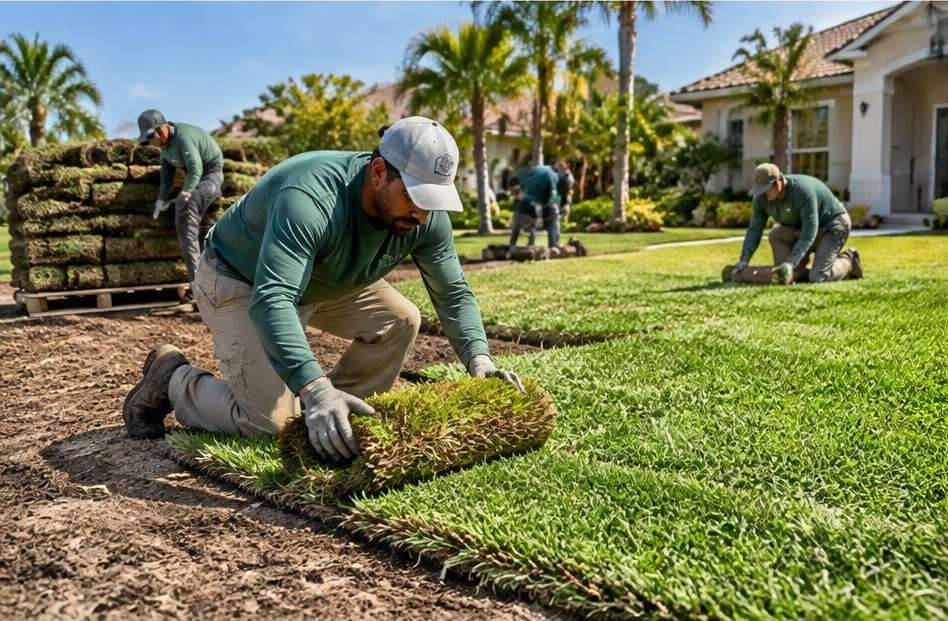
There are two different prices people mean when they ask about sod cost. The first is buying sod from a farm or supplier, often by the pallet, and laying it yourself. The second is a crew supplying, delivering and laying the sod, usually with some preparation of the ground. The installed price is higher because it includes labor, equipment, delivery and the work needed to get the soil ready.
Sod is sold by the pallet in most of Florida. A pallet covers a fixed number of square feet, which varies by farm and grass variety, so ask the supplier for the exact coverage before you order. Pricing can also change with the season and with whether the sod is a common variety such as Floratam or a less common one.
What changes the price
Lawn size is the biggest factor, but the work around the sod often decides whether a quote is high or low. Removing an old, dead or weedy lawn, grading uneven ground, adding topsoil or organic matter, repairing irrigation and hauling away debris are each separate line items on a good quote. A new-construction lot with compacted builder fill needs more preparation than a lawn that was healthy last year.
Other factors include how far the sod travels, whether the crew can get equipment into the yard, slopes and tight corners that slow the work, and the grass variety. Small jobs often cost more per square foot than large ones because delivery and setup are the same either way. Ask each company what is included, and whether sod removal and disposal are priced separately.
How to measure your lawn
Break the lawn into rectangles, circles and triangles and measure each one. For a rectangle, multiply length by width in feet. For a circle, multiply the radius by itself and then by 3.14. Add the areas together and subtract any beds, patios or other areas that will not be sodded.
Order a little extra, commonly about 5 to 10 percent, to cover cuts around curves and edges. Having a few spare pieces is cheaper than a second delivery. If a company quotes you, ask how many square feet it measured and compare that to your own number.
Getting quotes that compare fairly
Ask every company for a written quote that lists the square footage, the grass variety, what site preparation is included, whether old turf is removed, who disposes of it, and what the first watering instructions are. A lower number that leaves out ground preparation is usually not cheaper, because new sod that is laid over compacted soil is the one most likely to fail.
University of Florida turfgrass specialist Laurie Trenholm says the most important factor in getting sod established is how well the ground is prepared, and recommends working in organic matter, clearing construction debris and leveling the site. A quote that includes that work is easier to compare than one that does not.
Ways to lower the cost
Sodding only the areas that need it, rather than the whole yard, is the simplest way to save money. If the lawn has bare patches from chinch bugs, drought or a broken sprinkler zone, fix the cause first and patch the dead areas. Doing your own removal of old turf and laying a few pallets yourself can also cut labor, though a poor job on a large area costs more to redo.
Water costs matter too. Establishing new sod can be one of the largest single uses of water at a home, according to a UF/IFAS Extension director, and watering rules in Polk County can change during a shortage order. Check the current rules for your address before you plan the job.
When to hire a pro
A crew makes sense for large lawns, sloped or uneven yards, new-construction lots and any job that needs grading or irrigation repair. Ask whether the company has installed sod in your part of Polk County, how it prepares the soil, and what it tells you about watering. Local crews that handle lawn care and sod are listed in our directory by city.
Sources
- HomeGuide: How much does St. Augustine sod cost?
- Lawn by Season: Sod installation cost in Florida
- UF/IFAS News: Summer sodding and lawn preparation
- Reddit r/landscaping: Sod pricing install (one homeowner's report)
Written by the Polk County Landscaping editorial team. Rules and prices change, so check the linked agency before you act. Spotted a mistake? Send a correction.