The short version
Bahia and St. Augustine are the two grasses most Polk County property owners are choosing between, and they are close to opposites. St. Augustine is the dense, dark, coarse-bladed lawn that fills most subdivisions. UF/IFAS Extension calls it the most commonly used lawn grass in Florida, and it needs water and feeding to look its best. Bahia is a low-maintenance grass that, in UF/IFAS words, does well with limited water and fertilizer inputs but does not make a carpet-like, dense lawn.
In short, St. Augustine wins on looks and shade, and bahia wins on drought, low inputs and sandy ground. Neither is a bad grass. The better question is which one fits your sun, your water and your tolerance for mowing. This guide compares them point by point, using UF/IFAS Extension publications, then looks at Floratam and Palmetto and ends with a choice by lot type. For a wider comparison that includes Zoysia, see our guide to St. Augustine vs Bahia vs Zoysia in Polk County.
Sun and shade
Shade is where the two grasses differ most. The UF/IFAS grass selection guide rates bahiagrass shade tolerance as fair and St. Augustine as good to excellent, depending on the cultivar. Even so, UF/IFAS cautions that St. Augustine, like Zoysia, still needs daily sunlight for most cultivars, so no turf is a fix for a lot under a dense oak canopy.
Within St. Augustine the cultivar decides. UF/IFAS says Floratam does not persist well where it gets less than 6 hours of sunlight a day. Palmetto does well in full sun or partial shade but not in dense shade, and Seville performs well in shade and full sun. Bahia has no shade-tolerant cultivar to offer, so it belongs in open sun. If you are unsure how much sun a yard gets, watch it on a clear day in summer, when the trees are fully leafed, before choosing.
Drought tolerance and watering once a week
UF/IFAS rates bahiagrass drought tolerance as excellent and St. Augustine as good. Both keep their green color longer in a dry spell than some other lawn grasses, but they cope differently. Bahiagrass forms an extensive, deep root system and, in UF/IFAS words, can survive for extended periods without water. In a long drought it goes into a drought-induced dormancy, turns brown and stops growing, then generally recovers soon after rain or irrigation. UF/IFAS adds that bahia should not be overwatered, because that weakens the turf and invites weeds. St. Augustine, by contrast, requires water to remain green and healthy and may need supplemental irrigation during extended dry periods.
That matters in Polk County, where Polk County Utilities customers are limited to one watering day a week under the current water shortage order. Our reading is that a bahia lawn takes a limited schedule more calmly, as it may brown in a dry spell and then come back, while a St. Augustine lawn shows stress sooner and depends on even sprinkler coverage. UF/IFAS advice for both is to water when the grass shows it needs it, with signs such as folded or blue-gray blades or footprints that stay visible, and to apply about half to three-quarters of an inch each time, following local restrictions. Our guide to Polk County Watering Days & Irrigation Rules has the current days and hours, and a lawn that is new is a special case, covered in How Often to Water New Sod in Florida.
Upkeep and mowing height
Bahia is the lower-input lawn. UF/IFAS says it needs fewer nutrients, does not form excessive thatch, and has relatively low maintenance needs, and its published annual nitrogen range for Central Florida is lower than the range for St. Augustine. Mowing is the catch. UF/IFAS recommends 3 to 4 inches every 7 to 14 days in active growth, and notes that bahiagrass leaves and seed head stems are very tough, so a sharp, heavy-duty rotary blade is needed or the grass is torn and looks ragged. Because bahia does not grow extremely tall, the mowing schedule is often dictated by seed head production. UF/IFAS notes that some people find the tall seed heads unattractive.
St. Augustine wants more attention. Standard cultivars such as Floratam are mowed at 3.5 to 4 inches, Palmetto at 3 to 4 inches, and dwarf cultivars such as Seville at 2 to 2.5 inches, never removing more than a third of the leaf at a time. UF/IFAS says St. Augustine produces thatch under high fertilization and irrigation, and it has poor wear tolerance, so it does not hold up to repeated foot or vehicle traffic. Bahia is rated poor for wear as well. Neither is a good choice for a lawn that doubles as a play field. On feeding, see our guide Florida Fertilizer Ban: What Polk County Allows, which also covers the weather and water rules that apply to both grasses.
Pests: chinch bugs and mole crickets
St. Augustine's main weakness is the southern chinch bug. UF/IFAS describes it as the major insect pest of St. Augustine, and the damage looks like drought, which is why it is often missed at first. Some cultivars are also susceptible to diseases such as gray leaf spot, large patch and take-all root rot. Our guide to Chinch Bugs in Florida Lawns: How to Spot and Stop Them covers the coffee can test and what to do next, and Brown Patch, Take-All Root Rot and Gray Leaf Spot covers the fungi.
Bahia has fewer problems but not none. UF/IFAS says bahiagrass is generally less troubled by insects, diseases and nematodes than other Florida lawn grasses, and that its most serious insect threat is the mole cricket, which burrows through the soil, damages roots and makes the grass wilt rapidly. Signs include tunnels and mounds. One more caution on products: UF/IFAS warns that many weed-and-feed fertilizers contain atrazine or metsulfuron, which damage bahiagrass, and that Floratam is not tolerant of atrazine herbicides when applied above 85 degrees Fahrenheit. Read the label for the grass you actually have.
Cold tolerance, cost level and appearance
Cold. Bahia varies by type. UF/IFAS says Pensacola tolerates hot and cold temperatures well and holds its color best in winter, Argentine tolerates cold well but loses color sooner when it cools, and common bahia is very susceptible to cold and is not normally recommended for lawns. In St. Augustine, UF/IFAS says Floratam has poor cold tolerance compared with other cultivars and Seville is cold sensitive, while Raleigh is cold hardy. St. Augustine also goes into winter dormancy in parts of the state and turns brown or tan until spring. We could not find a published frost-risk figure for Polk County, so treat any cold-hardiness claim for a particular lot as a question for Extension.
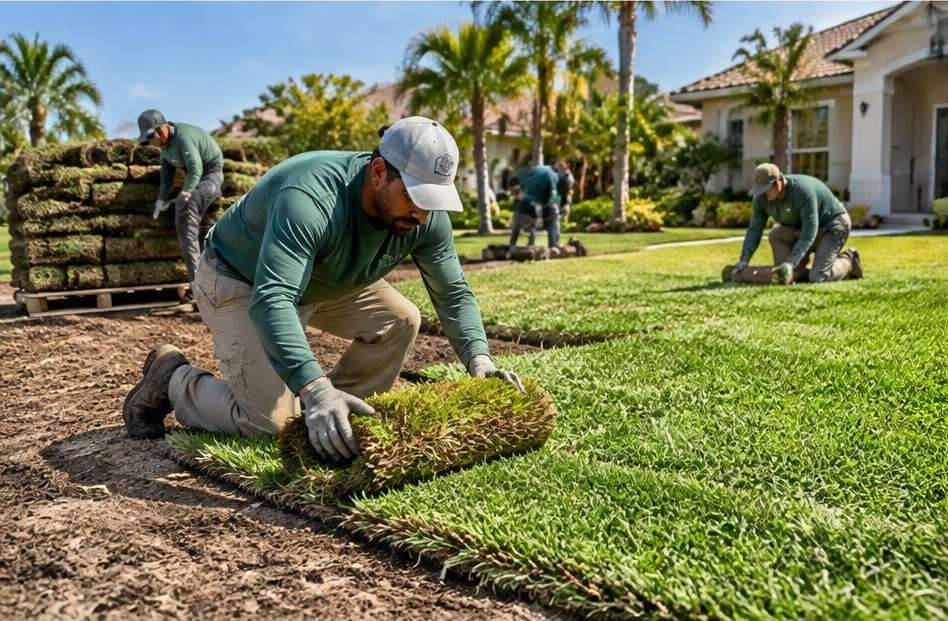
Cost level. We are not quoting prices, and Polk County prices vary by supplier and job. In general terms, UF/IFAS says bahia seed is abundant and relatively inexpensive, and that seeding costs less and takes less labor than sodding, though seed is slow to cover. Bahia sod is also an option, but UF/IFAS warns it is often harvested from pastures and may contain weeds, and the slabs can fall apart on installation. St. Augustine cannot be grown from seed and is planted as sod, plugs or sprigs, with sod the fastest. Our guide to How Much Does Sod Installation Cost in Florida? lays out published figures. Appearance. St. Augustine is green to blue-green and dense with coarse, wide blades. Bahia is looser and plainer; UF/IFAS says it has low density, and Argentine is the denser, darker, wider-bladed type.
Floratam vs Palmetto
Floratam and Palmetto are both St. Augustine, and the choice between them is one of the most common questions on a sod order. Per UF/IFAS, Floratam was released in 1973 by the University of Florida and Texas A&M and is the most widely produced and used St. Augustine in Florida. It is coarse-textured, grows vigorously in spring and summer, and has poor cold and shade tolerance relative to other cultivars. When it was released it had documented chinch bug resistance, but that has largely been lost over time, and chinch bugs are now a major pest of Floratam. UF/IFAS also lists susceptibility to gray leaf spot, and notes that Floratam infected with sugarcane mosaic virus can develop a lethal viral necrosis that kills it.
Palmetto was a selection found by a Florida sod grower in 1988 and released in the mid-1990s. UF/IFAS calls it semi-dwarf, with a shorter growth habit than many cultivars, a lighter green color, and a recommended mowing height of 3 to 4 inches. It does well in full sun or partial shade but not in dense shade. It is sometimes called drought tolerant, but UF/IFAS says research has not shown any greater drought tolerance than other St. Augustine cultivars, and that Palmetto is not insect resistant and can have disease problems in Florida's humid climate. In short, Palmetto is the more forgiving choice for a yard with some shade, and Floratam is the sun-loving standard. Neither escapes chinch bugs. UF/IFAS describes other cultivars as well, including CitraBlue, which it says is more drought tolerant than Floratam, Palmetto and Raleigh. Ask the sod supplier which cultivar is on the truck.
Which to choose, by Polk lot type
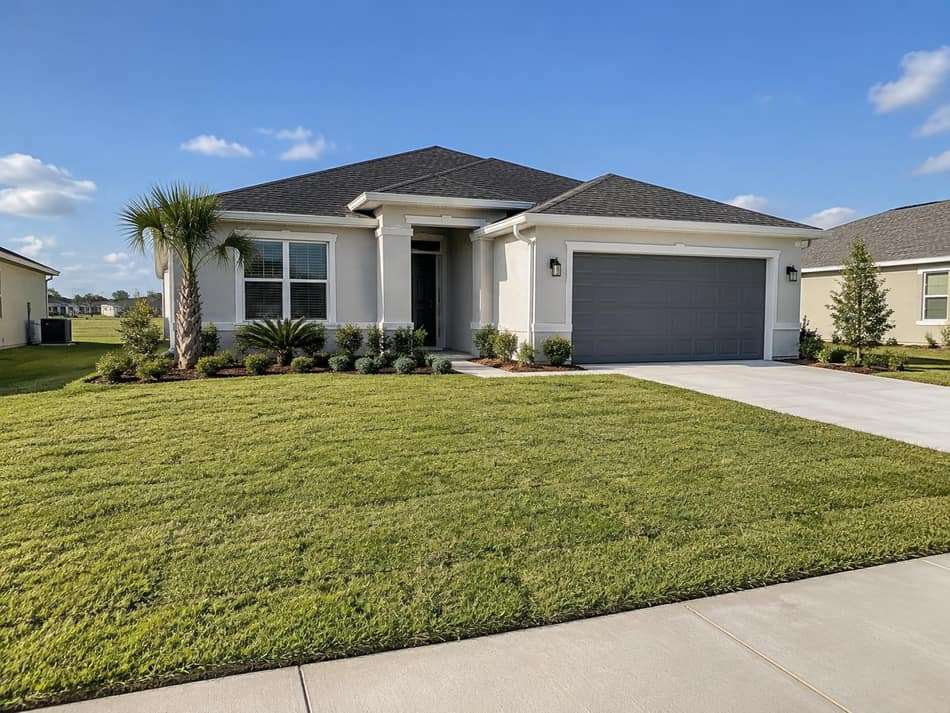
These are our readings of the UF/IFAS information, not a site visit. A sunny, irrigated subdivision lot with an HOA that expects a dense, dark lawn points to St. Augustine, with Floratam where there are 6 or more hours of sun and Palmetto where there is partial shade. A lot with oaks, morning sun only, or a north-facing yard points to a shade-adapted St. Augustine cultivar, with realistic expectations, and in dense shade to mulch or groundcover instead of turf. A large rural or acreage lot without irrigation points to bahia, which UF/IFAS calls a good choice for home sites on large lots or acreage or anywhere without an irrigation system, and which persists better than other grasses on infertile sandy soils. Expect seed heads and a plain look, and note that the UF/IFAS assessment of bahiagrass carries a caution to manage it to prevent escape, so keep it away from natural areas and shorelines.
Some lots sit between the two. A sunny, sandy lot on a one-day-a-week schedule where you want low upkeep may suit bahia if the neighborhood allows it, so check your covenants first, because many HOAs specify the grass. A lot with a history of chinch bug patches may reason against Floratam. High-traffic yards suit neither. Whatever you pick, replace a failed lawn only after you know why it failed, and see our guide to St. Augustine vs Bahia vs Zoysia in Polk County for the wider picture and How to Lay Sod in Florida: Step-by-Step Guide for installation.
Sources
- UF/IFAS Extension: Selecting a Turfgrass for Florida Lawns (ENH04/LH005)
- UF/IFAS Extension: Bahiagrass for Florida Lawns (ENH6/LH006)
- UF/IFAS Extension: St. Augustinegrass for Florida Lawns (ENH5/LH010)
- UF/IFAS Extension: Watering Your Florida Lawn (ENH9/LH025)
- UF/IFAS Gardening Solutions: Bahiagrass
- UF/IFAS Gardening Solutions: St. Augustinegrass
Written by the Polk County Landscaping editorial team. Rules and prices change, so check the linked agency before you act. Spotted a mistake? Send a correction.