Start with the pattern, not a product
Yellow St. Augustine grass has a long list of possible causes, and the fixes for them are different, sometimes opposite. Adding fertilizer to a lawn that is yellow from too much water makes it worse. Treating for insects when the real problem is shade wastes money. University of Florida turf specialists make the same point: diseases are the exception and not the rule for lawns, and patches of yellow or brown turf do not necessarily mean disease. Injuries such as pesticide damage or mowing too short, and disorders such as nutrient deficiencies, should be ruled out first.
So before you buy anything, spend ten minutes looking. Where is the yellow? When did it start? What changed in the last few weeks: a fertilizer or weed killer, a heavy rain, a sprinkler repair, a new fence or tree that changed the shade? The answers narrow the list quickly, and the sections below walk through the common causes in the order most worth checking.
A simple way to tell the causes apart
Use three clues: the shape of the yellow area, the time of year, and what the individual blades look like.
Yellow across a whole lawn or large zone, with no clear edge, points to nutrition or water. Yellow in irregular patches that spread outward, especially beside pavement or in full sun, points to chinch bugs. Round or ring-shaped patches that grow over weeks, in cooler damp weather, point to a fungus such as large patch (often called brown patch). Yellow that follows the shade of a tree or building, or lines up with the spray pattern of one sprinkler zone, points to light or water. Yellow that appeared within days of a weed killer points to herbicide injury. Yellow along the paths people or mowers always take points to compaction or scalping.
Then look closely at a few blades. UF/IFAS describes iron deficiency as showing up on the younger leaves first, because iron does not move around inside the plant. Nitrogen shortage tends to pale the lawn more evenly rather than in patches, which is our reading of the pattern, so confirm it with the soil test below. Spots on the blades point to leaf disease. Blades that pull easily out of the runner, with a dark, rotten-smelling base, point to a fungal problem at the base of the plant. None of these is a certainty, so treat the clues as a way to narrow the list, then confirm with the tests below.
Iron or nitrogen: two kinds of yellow
These two look alike and are often confused, but UF/IFAS Extension is clear that they are distinctly different deficiencies. Applying iron does not cure yellowing from nitrogen deficiency, and iron fertilizer is not a substitute for nitrogen.
Iron yellowing is common in Florida in spring, after a nitrogen fertilizer application, on St. Augustinegrass, bahiagrass and centipedegrass. The explanation in the UF/IFAS iron publication is that nitrogen pushes new growth, which raises the grass's demand for iron, while cool, wet soil and limited spring root growth hold back its ability to take iron up. Spring cases normally fade within a few weeks as the soil warms. UF/IFAS also notes that on soils above pH 7.0, or where high-pH water is applied, yellow blades may signal an iron or manganese shortage, and that foliar iron products, such as iron sulfate or chelated iron solutions, are what correct iron deficiency. Follow the product label on any iron product you buy.
Nitrogen shortage is the other common reason for a pale, thin, yellowish lawn, and it is treated with nitrogen applied according to Florida-Friendly Landscaping best management practices. Because Polk County's ordinance limits when and where nitrogen can be applied, see the section on local rules below before you reach for a bag.
Too much water, too little water and poor drainage
UF/IFAS lists over- and underwatering among the common reasons a lawn performs poorly. The signs of a thirsty lawn are folded or wilted blades, a blue-gray cast, and footprints that stay visible after you walk across it. A lawn that is yellow but wet, with soggy spots, algae or a sour smell, is more likely getting too much water or sitting where water cannot drain. Constantly wet soil also favors the fungal diseases covered below, and it limits how well roots take up iron.
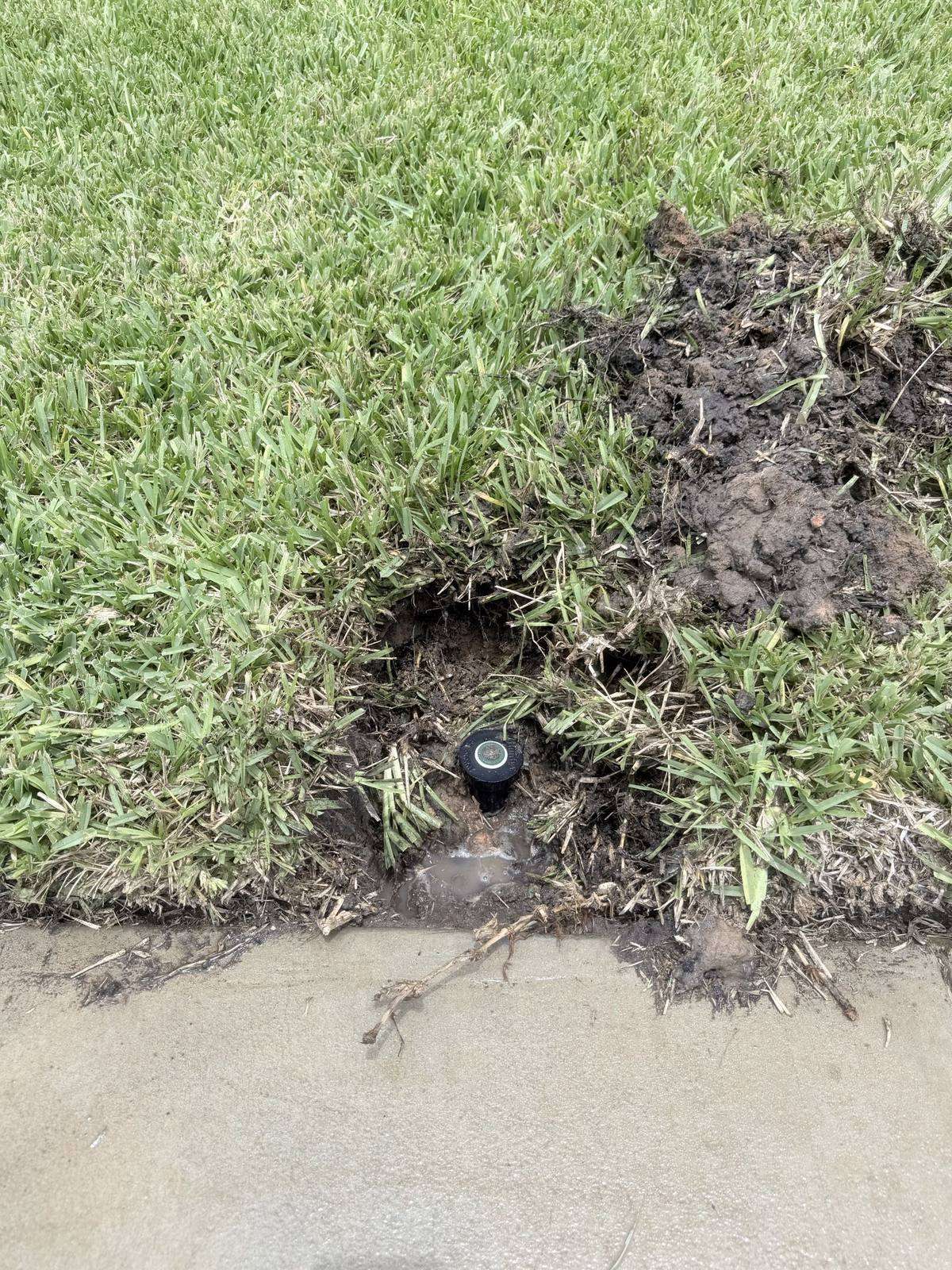
Because yellow often follows the shape of a sprinkler zone, walk the system while it runs. A sunken, tilted or clogged head leaves a dry strip next to an overlapping soggy one. If your sprinklers are the suspect, our guides on adjusting sprinkler heads and replacing a sprinkler head cover the fixes. Under Polk County Utilities' current once-a-week limit, even coverage matters more than ever, so a dry zone has no extra watering days to make up for it. Our guide to Polk County watering days and irrigation rules covers the current limits. UF/IFAS advises irrigating as needed, with about half to three-quarters of an inch per application, and changing how often you water with the seasons rather than how much.
Chinch bugs, fungus and root rot
Chinch bugs suck the sap from the blades and leave yellowish to brownish patches. UF/IFAS says injured areas are usually first noticed as the weather warms, along sidewalks, next to buildings and in other water-stressed spots in full sun. The coffee can test, with both ends cut out and the can pushed into the soil at the edge of the damage and filled with water, brings them to the surface, typically within about five minutes. Our chinch bug guide walks through the test and the treatment options. A patch that keeps growing in the heat and does not green up after watering is the usual story.
Three fungal diseases cause most of the other yellow patches on St. Augustine lawns here. Large patch, often called brown patch, is a cool-season disease that makes round or ring-shaped patches, mostly in fall and spring. Gray leaf spot appears in the summer rainy season and leaves oblong gray or brown spots on the blades. Take-all root rot rots the roots in the wet months and shows up above ground as irregular yellow or light green patches. Our guide to brown patch, take-all root rot and gray leaf spot in St. Augustine lawns describes each in detail. UF/IFAS adds that nematodes, microscopic soil worms, can also thin a lawn and slow its recovery, and that they can only be identified by a laboratory test.
Shade, compaction, mowing and herbicide injury
UF/IFAS lists excessive shade, compacted soil, traffic, improper mowing and high or low pH among the causes of a poor lawn. St. Augustinegrass is one of the more shade-tolerant warm-season grasses, but that varies a lot by variety. The UF/IFAS publication on the grass describes Floratam as poorly shade tolerant, and says that lawns in the shade should be mowed higher and need less fertilizer than lawns in full sun. If the yellow thin grass sits under a tree that has grown denser, the answer may be pruning the canopy, mulching under the tree instead of fighting for grass, or accepting a groundcover there.
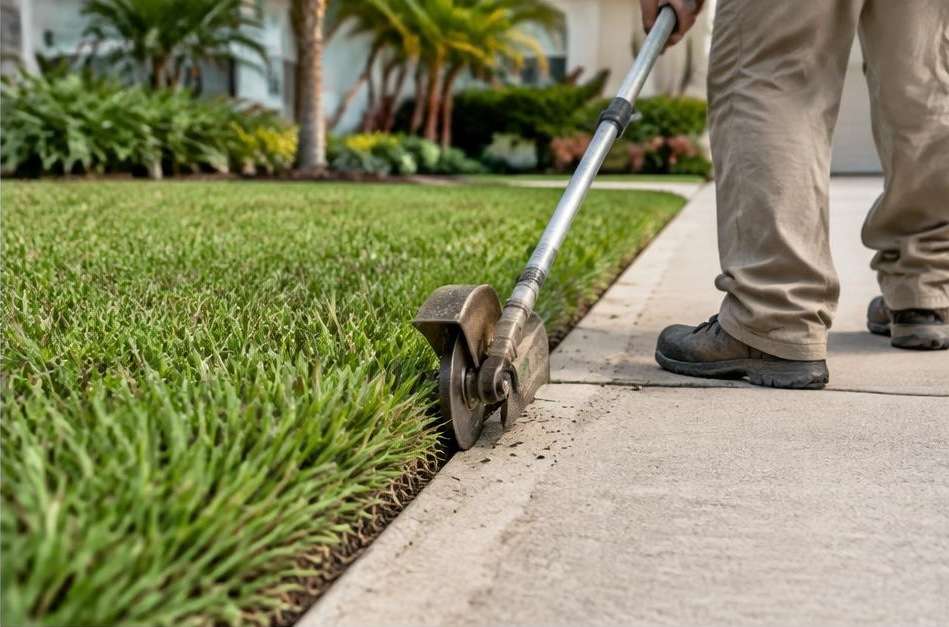
Mowing matters more than most people expect. UF/IFAS recommends 3.5 to 4 inches for standard St. Augustinegrass varieties and never removing more than a third of the blade at once. Scalping can injure the lawn, and dull blades shred the tips and give the lawn a brownish cast. Compaction tends to show up along paths where people, pets or mowers repeat the same route, so thin, yellow grass that follows a foot path is a compaction clue.
Herbicide injury is the other one to rule out. UF/IFAS warns that postemergence products such as atrazine should not be applied when the turf is under moisture stress or when air temperatures exceed 85 degrees Fahrenheit, which is most of a Polk County summer, and that Floratam is intolerant of atrazine. A lawn that yellowed within days to a couple of weeks of a weed killer, or of a weed-and-feed product, is a strong suspect. Always read the label for the grass type and temperature limits.
What the Polk County rules change
Two local rules shape the fix. First, Polk County Utilities customers may water once a week through March 2027, on a day set by the last digit of the street address. That limits how fast you can correct a dry zone, and it also makes it harder to overwater, so a lawn that is yellow and soggy in the middle of a once-a-week schedule is more likely suffering from drainage or heavy summer rain than from the sprinklers.
Second, Polk County has a fertilizer ordinance. Polk County's ordinance restricts fertilizer near water and before heavy rain; some cities and nearby counties add a summer ban, so check your city. The UF/IFAS Polk County guide to the ordinance lists these limits: no nitrogen or phosphorus fertilizer before seeding or sodding or for 30 days after, none during severe weather or when more than two inches of rain is likely within 24 hours, and none within 10 feet of a water body or wetland. It also caps a single application at one pound of slow-release nitrogen per 1,000 square feet. Whether an iron-only product is treated differently is a question for the county or your city. UF/IFAS advises that the first fertilizer application of the year in Central Florida should go on in early April.
Soil test and when to call UF/IFAS Extension
A soil test is the cheapest way to stop guessing. UF/IFAS says a soil test should be done to find out which nutrients are available to the lawn and what the pH is, and that the local Extension office has instructions and supplies. The UF/IFAS Extension Polk County office can explain how to collect a sample and where to send it. The test tells you about pH and nutrient levels. It will not tell you how much iron to apply: UF/IFAS says iron applications should not be based on soil test iron levels, because soil iron changes quickly and test calibrations have not been established on Florida soils.
Call or email Extension when the cause is still unclear after you have checked water, mowing, shade and the chinch bug test; when a patch keeps spreading; when you suspect a disease and want a sample looked at by the UF/IFAS Plant Diagnostic Center; or when you think nematodes may be involved. If you hire a company, ask what it found and how it found it before it sprays or fertilizes. A good answer names a cause, not just a product.
Sources
- UF/IFAS Extension: St. Augustinegrass for Florida Lawns (ENH5/LH010)
- UF/IFAS Extension: Iron for Florida Turfgrasses (ENH1287/EP551)
- UF/IFAS Extension: Turfgrass Disease Management (SS-PLP-14/LH040)
- UF/IFAS Gardening Solutions: Large Patch (Rhizoctonia Blight) in Florida Lawns
- UF/IFAS Extension Polk County: Residents Guide to the Polk County Fertilizer Ordinance
Written by the Polk County Landscaping editorial team. Rules and prices change, so check the linked agency before you act. Spotted a mistake? Send a correction.