Which palms need trimming and which do not
Not every palm needs a haircut. UF/IFAS Gardening Solutions explains that palms with a crownshaft, the smooth, non-woody section a few feet below the fronds, drop their old fronds on their own roughly once a month. It names royal palms, foxtail palms and Christmas palms as examples. If you own one of these, trimming usually means picking up what fell, not cutting anything.
UF/IFAS says that on other palms, some dead fronds fall on their own while others stay attached or hang loosely against the trunk. Those are the palms people mean when they ask how to trim palm trees. UF/IFAS also points out that dead fronds are a normal part of palm growth and do not harm the tree, so trimming them is mostly about appearance and about keeping heavy fronds from falling on people or property.
What to remove and what to leave
The rule UF/IFAS puts first is never to remove live, green, healthy fronds. Green fronds make the food the palm lives on, and every cut leaves a wound that can let disease in. The working rule of thumb is to remove only fronds that are completely brown. A Pasco County UF/IFAS Extension article adds that broken fronds, and seeds or fruit, are also acceptable to remove.
Leave half-dead and yellowing fronds alone. UF/IFAS says they may signal a nutrient deficiency and still supply the palm with some nutrients, although some palms, such as areca palms, naturally yellow with age. If many fronds are yellowing or spotting, that is a nutrition or health question, not a trimming question, and a certified arborist or your county Extension office can help diagnose it.
Seed pods and fruit stalks are the other thing to remove. Heavy fruit clusters can fall and make a mess or a hazard, and UF/IFAS says there is no evidence that removing living flower or fruit stalks harms the palm. To protect pollinators, it suggests waiting until the blooms have dropped and the fruit has begun to develop before cutting the stalks.
The hurricane cut myth
A "hurricane cut" (also called hurricane pruning, or a pineapple cut) removes most of a palm's fronds on the theory that a smaller crown catches less wind. UF/IFAS Gardening Solutions calls the practice common in Florida and harmful to palms, and says it is not rooted in science and actually makes trees less able to withstand hurricane-force winds. Observations in Florida after hurricane seasons, UF/IFAS says, have shown that hurricane-cut palms were more likely to have their crowns snapped off by the wind.
The Pasco County Extension article is blunt: hurricane pruning is a myth, and it also advises against tying or strapping palms down, because palms are flexible and restraints can make them more likely to break. Our guide Hurricane Season Tree & Palm Prep for Polk County covers what is worth doing before June 1. For palms, the answer is the same as any other month: take off only the dead material.
Why over-pruning hurts a palm
A palm has one growing point, the bud at the center of the crown, and it cannot be replaced the way a branch on an oak can. Taking green fronds away starves the palm of the food they make. The Pasco County article describes the result as pencil-pointing, where the crown thins down and the bud can break from the trunk. Because the bud is the growing point, losing it can kill the palm.
UF/IFAS gives a visual limit. On a clock face drawn over the canopy, pruning past the 9 o'clock and 3 o'clock positions is the absolute limit, not the ideal. Fronds that point up or straight out are the ones holding the crown together. The goal is a round, full canopy with green leaves down to the bottom, which looks different from the stripped look some crews and neighbors expect.
Tools and safety
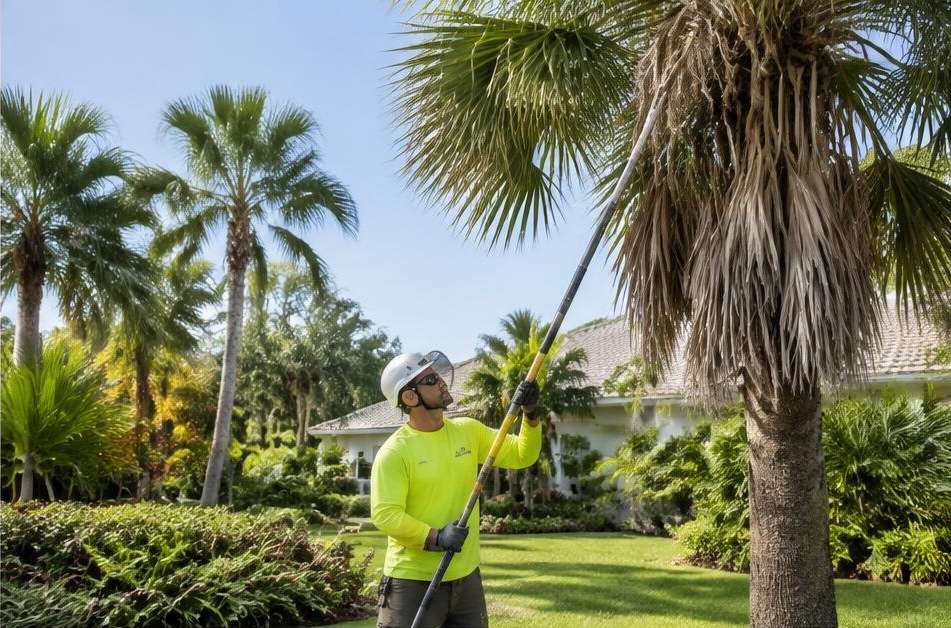
For palms you can reach from the ground, a pole saw or pole pruner and a pair of loppers or a hand saw handle most fronds. A sharp tool makes a clean cut close to the trunk without cutting into it. The Pasco County article says to sterilize tools between palms to avoid spreading pests and disease. Wear eye protection, gloves, long sleeves and a hard hat, because dead fronds fall straight down.
UF/IFAS Gardening Solutions says never to use climbing spikes, which damage the trunk. It also says never to force off a frond that does not come away easily, since tearing creates an entry point for disease. Ladders are the other common injury source. Set them on firm ground, and do not work from one at the top rungs while holding a saw overhead.
Power lines change everything. Florida Power & Light's safety guidance says to keep yourself and anything you are holding, including a pole saw, at least 10 feet from neighborhood power lines, and warns that even nonmetallic ladders and equipment can conduct electricity. It says never to attempt to trim vegetation growing near power lines and that only specially trained line-clearing professionals should work around them. If your power comes from a different utility, ask it for its own clearance rule.
Step by step: trimming a palm you can reach
First look up. Note any power lines, nearby roofs and tree limbs, and confirm the palm is short enough that you can work from the ground or a stable ladder. Lay a tarp or clear the ground below, and keep children and pets away. Sterilize your saw or pruner before you start, and again between palms.
Work from the bottom of the crown up. Cut off only fronds that are fully brown, close to the trunk but without cutting into it. If a dead frond does not come away with a clean cut, leave the stub rather than pulling or tearing the frond off. Then take off the seed pods or fruit stalks if you want them gone, keeping to the timing advice above. Stop when you reach the 9 o'clock and 3 o'clock positions, even if a few green fronds below that line look untidy.
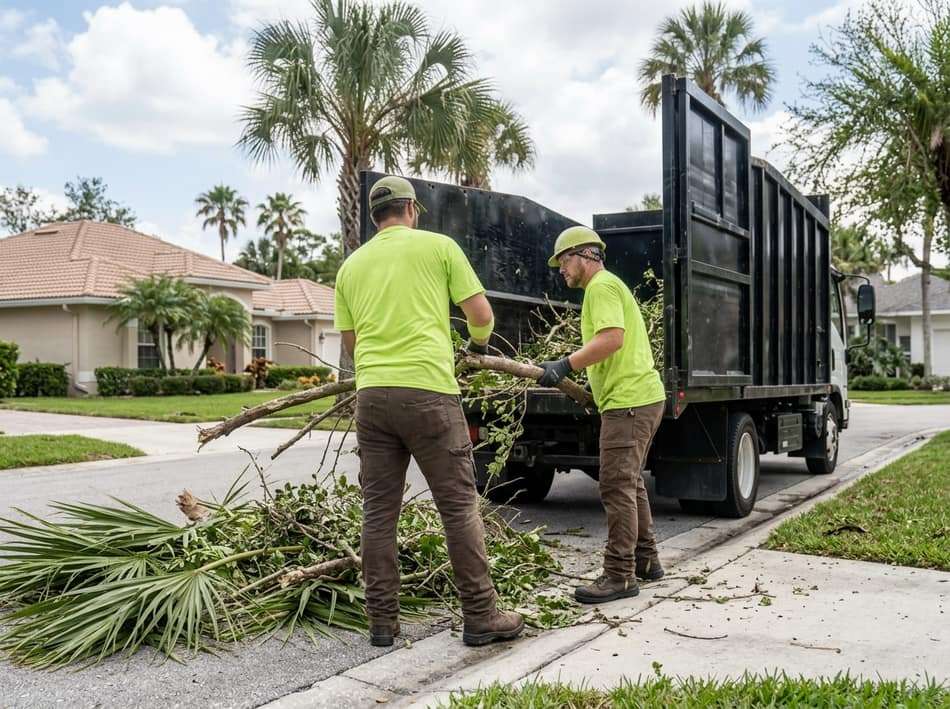
Finish by bagging or stacking the debris. Palm fronds are heavy and bulky, and yard-waste pickup rules differ by city and hauler. Check your hauler's rules before you start cutting, and plan where the debris will go.
When to trim
UF/IFAS Gardening Solutions says no single time is best. Commercial crews work on a fixed schedule, and homeowners can prune whenever it is convenient, as long as they follow the rules above. There is no benefit to cutting a palm hard just before hurricane season, and the cutting should not wait for a storm warning either, because a frond that is brown and hanging is a hazard in any month.
A practical routine is to look at your palms two or three times a year, take down what is fully brown, and clean up seed pods once the fruit has formed. That keeps the amount of material small, which makes the job safer and easier to do from the ground.
When to hire an arborist
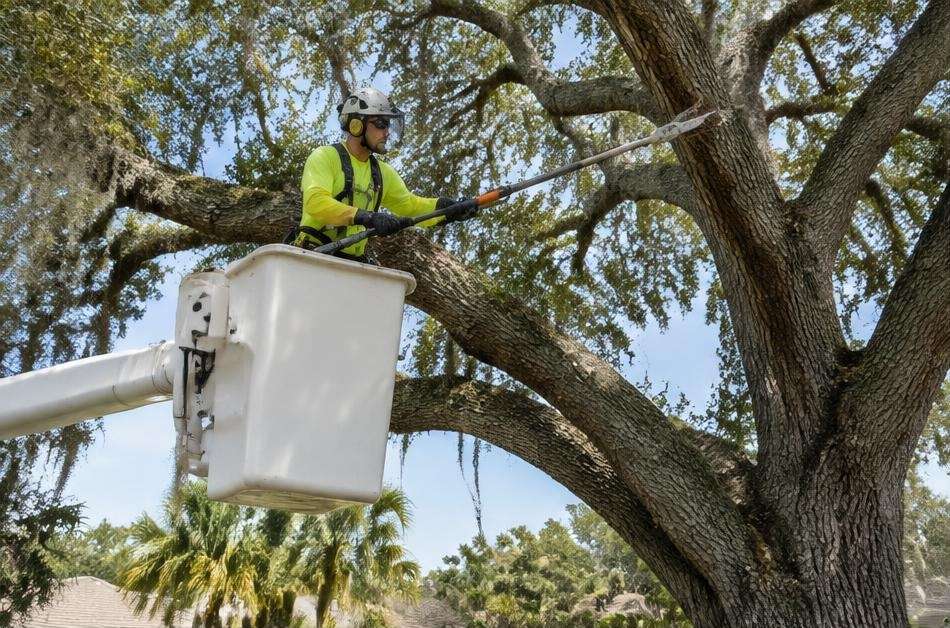
Call a professional when the palm is tall enough that you would need to climb or use an extension ladder, when any part of the crown or your equipment could come near a power line, or when the palm looks unhealthy. A crew working on a tall palm uses climbing gear or a bucket truck, and UF/IFAS suggests considering a certified arborist trained in palm health. Our guide How Much Does Tree Trimming Cost in Florida? covers what published estimates say about price, including how height drives the cost.
Ask what the crew will remove before they start, and be wary of anyone who proposes to strip the crown. A company that recommends a hurricane cut is not following current UF/IFAS guidance. A good company will tell you it takes off only dead fronds and seed pods, and will say the same in the written scope.
Sources
- UF/IFAS Gardening Solutions: Pruning Palms
- UF/IFAS Extension, Pasco County: Preparing Palms for Hurricane Season in Central Florida
- Florida Power & Light: Power line safety
Written by the Polk County Landscaping editorial team. Rules and prices change, so check the linked agency before you act. Spotted a mistake? Send a correction.